

For most of the last five hundred years, the West told a tidy origin story about oil painting. The medium, so the story went, was perfected — if not outright invented — in fifteenth-century Flanders by Jan van Eyck, then carried south into Italy, refined across the Baroque, and brought to its emotional summit by Rembrandt. It is a beautiful narrative. It is also incomplete. In 2008, a team of conservation scientists analysing damaged murals in the cliffside caves of Bamiyan, in central Afghanistan, announced something that quietly rewrote the timeline: the earliest known oil paintings in the world were made there in the middle of the seventh century — roughly six to nine hundred years before Van Eyck ever ground a pigment.
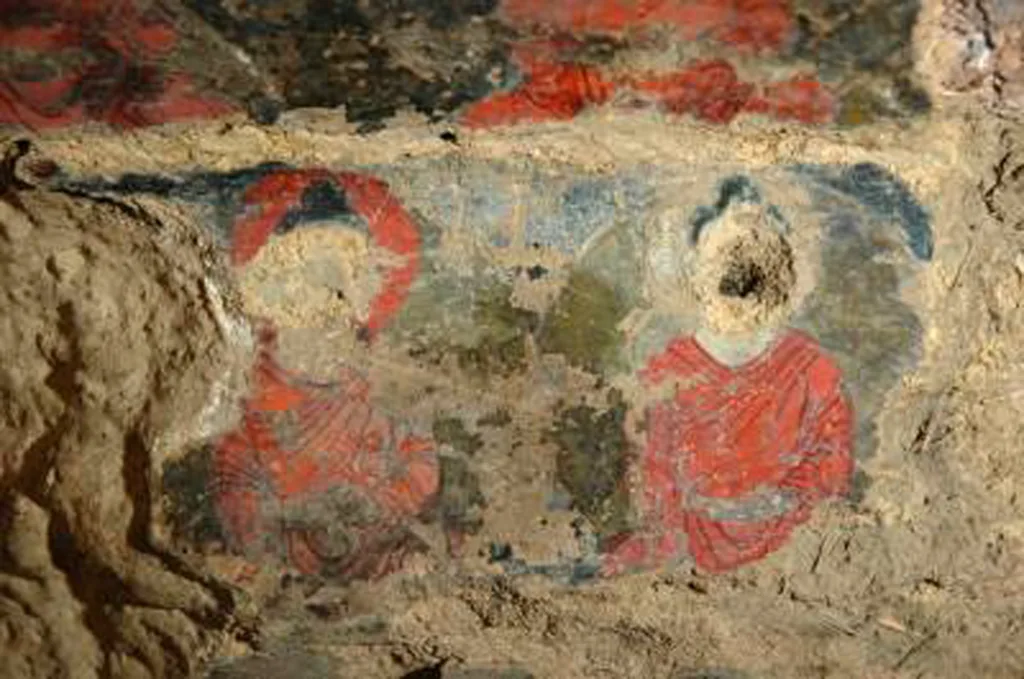
The Bamiyan valley is best known today for tragedy. It once held two colossal standing Buddhas carved directly into the sandstone cliffs, monuments of the Silk Road that stood for some fourteen centuries until they were dynamited in 2001. But behind and around those giant figures lies a honeycomb of painted caves, decorated by the Buddhist monks and travelling artists who passed through this crossroads between India, Persia, and China. When researchers led by Yoko Taniguchi, working with synchrotron facilities in Europe including the ESRF in Grenoble, examined tiny fragments of these murals, they found that the paint binder was not the egg or animal glue one might expect. It was drying oil — walnut oil and poppy-seed oil — the very same class of vegetable oils that European painters would later treat as their signature innovation.
It is worth dwelling on how this discovery was even possible, because the science is as remarkable as the finding. For decades the Bamiyan murals were assumed, like most ancient wall paintings, to be bound in glue, egg, or natural gums. Confirming otherwise required examining paint fragments barely visible to the eye, and the researchers turned to synchrotron facilities — enormous machines that accelerate electrons to produce intensely bright beams of light and X-rays. By probing microscopic samples with these beams, and combining the results with other analytical techniques, the team could identify the specific molecular signatures of drying oils and even distinguish walnut from poppy-seed oil, layer by layer, without destroying the precious fragments. The murals themselves, painted between roughly the fifth and ninth centuries with a concentration in the seventh, depict seated Buddhas, mythological creatures, and robed figures in a style that fused Indian, Persian, and Hellenistic influences — the visual fingerprint of the Silk Road, the great artery of trade and ideas along which this valley sat. That an oil technique should surface here, of all places, is fitting: Bamiyan was a crossroads where materials, motifs, and methods from three continents met and mingled.
This matters for reasons that go beyond a footnote in a textbook. Oil, as a binder, behaves unlike anything that came before it. Egg tempera dries in minutes and locks colour into flat, matte, fast strokes. Oil dries slowly, stays workable for hours or days, and can be built up in translucent films that let light pass through and bounce back. The painters of Bamiyan understood, at least intuitively, that suspending pigment in a slow-drying oil gave them a material with a longer working life and a different optical character. That is precisely the discovery on which the entire European tradition of glazing, blending, and luminous depth would later be built.
So did the Bamiyan caves become the foundation of Rembrandt and Van Eyck in a literal, documented, hand-to-hand sense? Here honesty serves the story better than legend. There is no surviving chain of workshops, no annotated treatise carried west by a traveller, no proof that a Flemish master ever heard of an Afghan cave. The oil technique appears to have been discovered more than once, in different places, by artisans solving the same practical problem with the same abundant material — pressed seeds and nuts. What Bamiyan gives us is not a bloodline but a correction of perspective. It tells us that oil painting is not a European invention at all. It is a human one, and it is far older and more geographically dispersed than the Renaissance chroniclers imagined.
Understanding this deep history changes how we look at the masterpieces we love. When you stand before a Van Eyck and marvel at the impossible clarity of a jewel or the moisture in an eye, you are seeing the mature European flowering of a principle — pigment floating in oil, layered thin over a bright ground — that had already been used, on the other side of the known world, to render the robes and haloes of the Buddha. The genius of the fifteenth-century Netherlanders was real, but it was the genius of refinement and system, not of first invention. They standardised the oils, learned to control drying with additives and grounds, and married the technique to a new appetite for realism. They took a possibility and turned it into a language.
For a gallery and for anyone who lives with paintings, the Bamiyan story offers a useful humility and a useful pride at once. Humility, because it reminds us that no single culture owns the tools of art; the medium in our most treasured oil canvases has roots along the Silk Road, in Buddhist devotion, in the practical wisdom of anonymous craftsmen. Pride, because it shows how durable a good idea can be. A technique worked out in a mountain cave in the 600s, using nothing more exotic than walnut oil, is fundamentally the same technique that produced The Arnolfini Portrait and The Night Watch — and the same one a contemporary painter reaches for today when they want colour to glow rather than merely sit.
This raises a natural question: if oil was being used in Central Asia in the seventh century, why did Europe take so long to adopt it, and why do we still credit the Renaissance with the “invention”? The likeliest answer is that there was never a single invention to credit. Painters in many places pressed the same nuts and seeds for lamp oil, cooking, and varnish, and some of them noticed that these oils, mixed with pigment, made a slow-drying, workable paint. In medieval Europe oil was known and used well before Van Eyck — mentioned in craft treatises, employed for coating shields, decorating stonework, and varnishing tempera panels — but it was treated as a coarse, utilitarian material, not the vehicle for serious picture-making. What changed in fifteenth-century Flanders was not the discovery of oil but a leap in refinement: painters worked out how to purify the oils, control their drying, pair them with luminous grounds, and exploit their transparency for effects tempera could never achieve. The Bamiyan evidence simply confirms what this history implies — that oil painting has no single birthplace, and that the European “invention” was really the European perfection of a much older and more widely scattered idea.
There is also a conservation lesson embedded here, and it is one collectors quietly benefit from. The Bamiyan murals survived, in fragments, for thirteen centuries in a harsh climate precisely because oil forms a tough, flexible, insoluble film once it cures. That same chemistry is what allows a well-made oil painting to remain vivid on your wall for generations. When we talk elsewhere in this journal about why oil classics anchor a collection, this is the physical fact underneath the sentiment: oil is not only beautiful, it is remarkably long-lived.
The next time the familiar Van Eyck-invented-oil story comes up, it is worth telling the fuller version. Oil painting did not begin in Bruges. It begins, as far as we currently know, in the painted caves of Bamiyan, in the seventh century, with monks and drying oil and the same quiet wish that has driven painters ever since: to make light live inside a picture. Rembrandt and Van Eyck are not the founders of that wish. They are its most celebrated inheritors.