
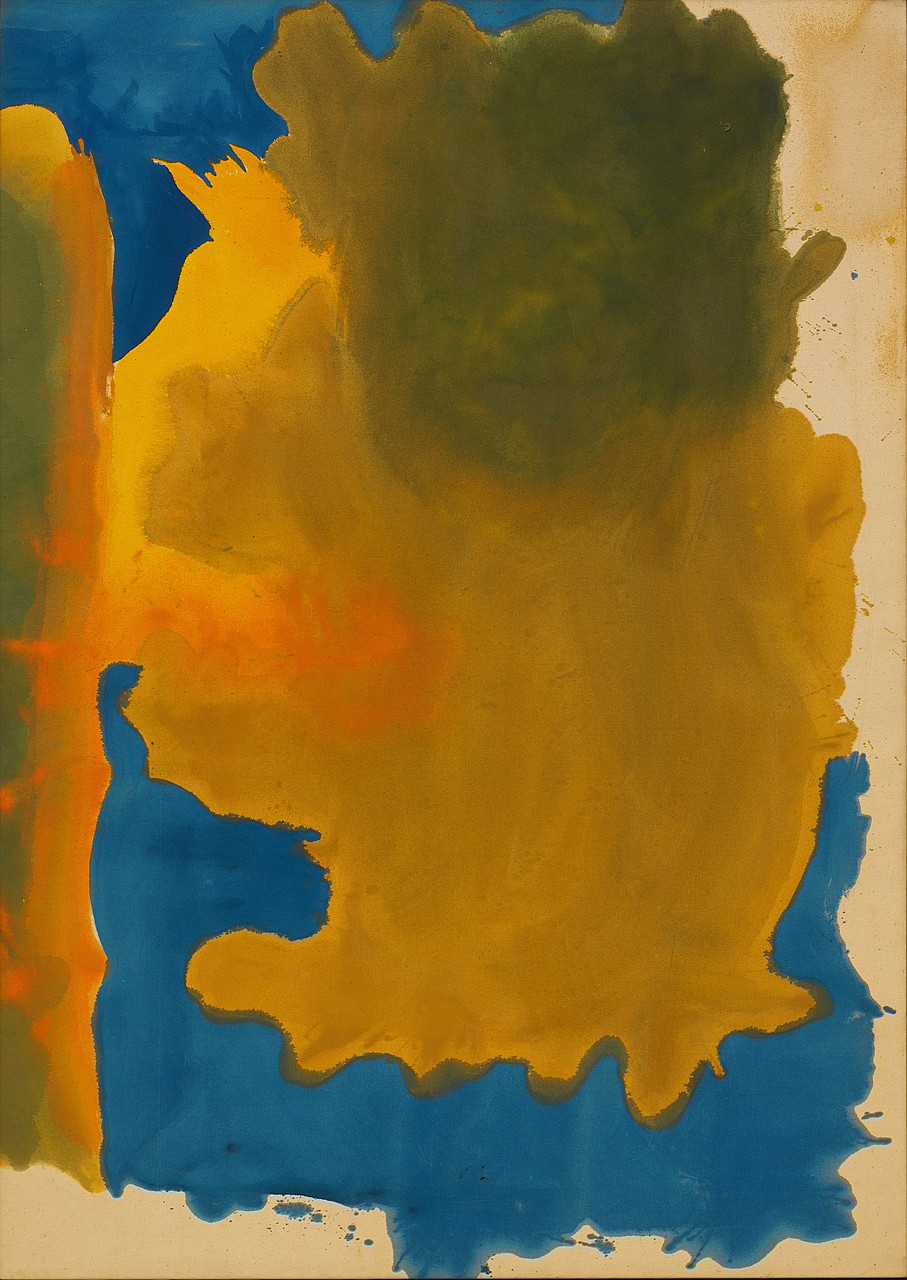

In 1952, a young painter named Helen Frankenthaler laid an unstretched, unprimed canvas flat on the floor of her New York studio and poured paint onto it, thinned until it flowed like watercolour. The pigment did not sit on the surface. It sank into the raw cotton, spreading and blooming along the weave, staining the fabric the way ink stains paper. The painting that resulted, Mountains and Sea, looks like a landscape breathed onto the canvas rather than constructed on it — translucent washes of blue, green, and rose that seem to have no edges, no brushmarks, no hierarchy of figure and ground. It became one of the most influential paintings of the postwar era, and it opened a path that a new medium would soon make fully navigable. That medium was acrylic.
To appreciate why acrylic mattered here, it helps to know what Frankenthaler was fighting against. Oil paint, for all its glories described elsewhere in this collection, is a poor partner for staining. Oil poured onto raw canvas eventually rots the fibres; the acids in the oil attack the cotton over time, and the halo of oil that seeps out around a thinned stain can degrade the fabric and darken unpleasantly. Frankenthaler’s early stain paintings were in fact made with oil heavily thinned with turpentine, and conservators have worried about them ever since. She had found a revolutionary idea — colour soaked into the canvas so that image and support become one thing — but the material she used to achieve it was working against her. What she needed was a paint that could be thinned to a flowing wash, would soak into raw cotton, would bond to it permanently without destroying it, and would keep its colour indefinitely.
That is almost a specification for acrylic paint, which arrived at exactly the right moment. Acrylic is pigment suspended in an acrylic polymer emulsion — essentially a fine plastic dispersed in water. When the water evaporates, the polymer particles fuse into a clear, flexible, extremely stable film that grips the pigment and the canvas. Because the vehicle is water, acrylic can be diluted endlessly into thin, flowing stains without the fibre-rotting problems of oil. Because the dried film is a stable plastic, it does not yellow, crack, or embrittle the way thinned oil does, and it does not bleed a destructive halo into the fabric. The first artists’ acrylics became commercially available in the United States in the 1950s — early water-based acrylic emulsion paints such as those sold under the Liquitex name appeared in the mid-1950s — and painters interested in staining seized on them almost immediately.
A small but important clarification belongs here, because the history of acrylic itself is not one clean product but two overlapping ones. The first artists’ acrylics to reach American painters, from the paint-maker Leonard Bocour under the name Magna, were solvent-based — pigment in an acrylic resin thinned with turpentine rather than water — and it was this early acrylic that Morris Louis in particular used for much of his stained work. Water-based acrylic emulsion paints, the kind we now think of as “acrylic,” followed in the mid-1950s and came to dominate afterward. For the story of staining the distinction matters less than the shared virtue: both forms were built on stable acrylic resins that could be thinned to a flowing wash, soaked into raw canvas, and dried to a clear, non-yellowing, fibre-friendly film. Whichever formulation a given painter reached for, the acrylic resin at its heart was what made permanent staining possible.
The two artists most associated with taking Frankenthaler’s discovery into acrylic are Morris Louis and Kenneth Noland, who visited her studio in 1953, saw Mountains and Sea, and reportedly described it as a bridge between the gestural intensity of Jackson Pollock and a new possibility of pure, poured colour. Louis in particular built an entire mature body of work on the soak-stain principle using thinned acrylic resins: his Veils and Unfurleds are made of overlapping translucent waves and rivulets of colour flowing down raw canvas, the paint so fully integrated into the fabric that there is no paint layer to speak of, only stained cloth. This became the core of what the critic Clement Greenberg championed as Color Field painting or Post-Painterly Abstraction — an art that set aside the thick, agitated brushwork of Abstract Expressionism in favour of flat, open, luminous expanses of colour. And it was, to a significant degree, an art made possible by acrylic’s specific chemistry.
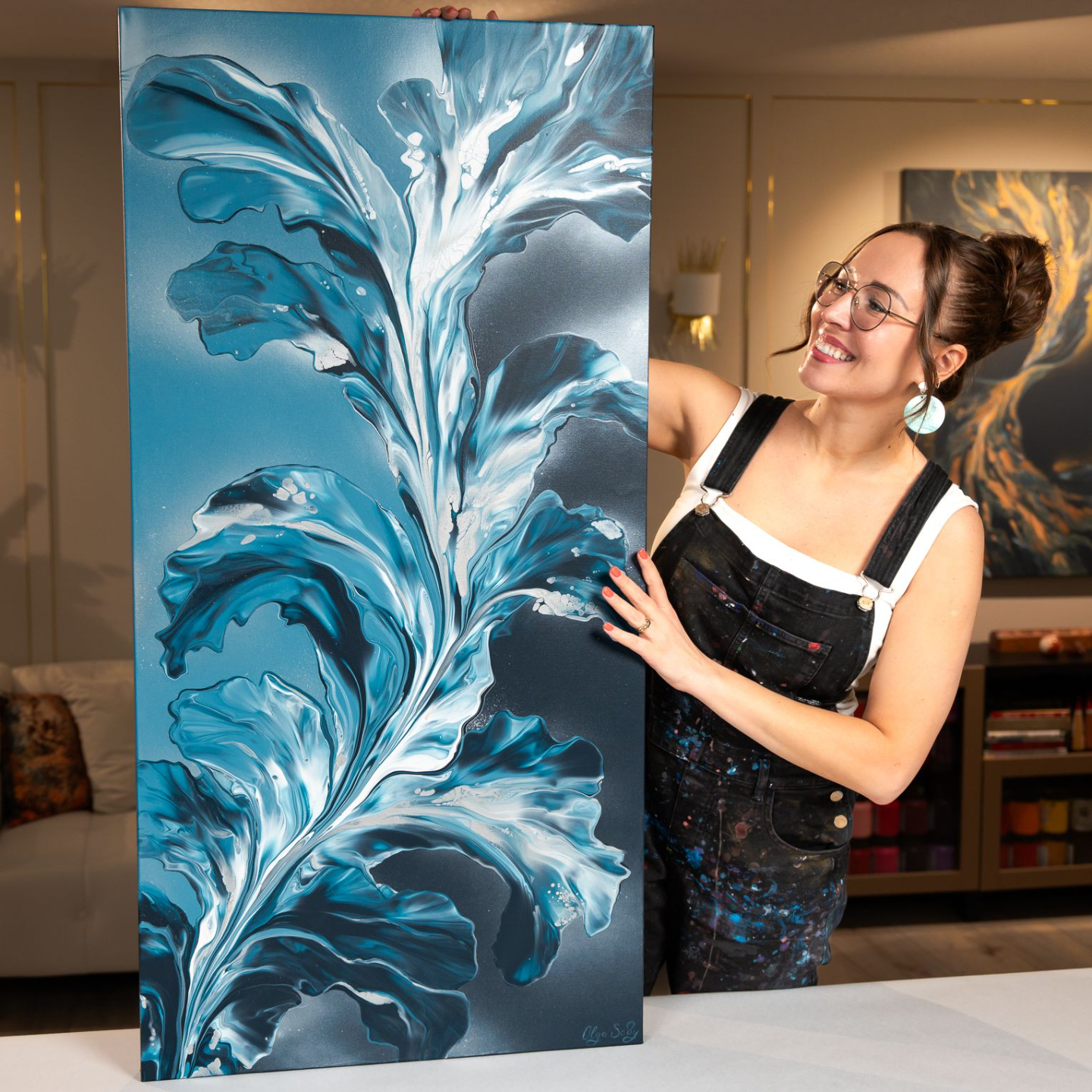
It is worth being precise about what acrylic enabled, because it is a clear example of a material unlocking a style. First, permanence: acrylic let painters stain raw canvas without slowly destroying it, which meant the soak-stain idea could become a durable body of work rather than a fragile experiment. Second, flatness and openness: because acrylic sinks in rather than building up, it produces an image with no relief, no impasto, no glossy oil skin catching the light — exactly the matte, breathing, weightless surface Color Field painting wanted. Third, colour clarity: acrylic dries with very little shift in hue and does not yellow with age, so a poured field of pink or acid green stays as clean and bright decades later as the day it was made, which is essential to an art where colour is the subject. Fourth, water-based practicality: thinning with water rather than solvents let artists work on a large scale, on the floor, quickly, pouring and tilting and directing flows, without a studio full of turpentine fumes.
There is a broader point here about how innovation actually happens in art. We often imagine the artist as a pure originator of ideas, and Frankenthaler’s leap of imagination — that a painting could be a stain rather than a construction — was genuinely hers. But ideas need materials that can carry them, and the full flowering of the soak-stain approach waited for a paint that matched the concept. Frankenthaler supplied the vision in thinned oil; acrylic supplied the means to realise that vision cleanly, permanently, and at scale. The 1950s and 60s were a rare moment when a radical new pictorial idea and a radical new medium met and amplified each other.
Frankenthaler’s own position in this story deserves emphasis, because it is easy for the men who followed to overshadow the woman who opened the door. She made her breakthrough at twenty-three, in a New York art world that took male gestural painters far more seriously than their female peers, and yet Mountains and Sea proved to be one of those rare works that changes the direction of a whole field. She continued to develop the stain technique for decades, growing ever more assured in her handling of poured, soaked colour and increasingly working in acrylic as the medium matured, and her later paintings show a command of the method’s atmospheric, landscape-like suggestion that few equalled. The critical framework built around Louis and Noland — Greenberg’s Post-Painterly Abstraction — sometimes described the movement as though it sprang from the critics’ theories, but the generative act was hers: a young painter on the floor of a studio, pouring thinned colour into raw canvas and recognising that she had found something new.
For the way we look at these paintings today, the medium is not a technicality to be filed away but part of the meaning. The weightless, glowing, edgeless colour of a Frankenthaler or a Louis is inseparable from the fact that it is in the canvas rather than on it, and that quality is a gift of acrylic. When you stand before one, you are seeing not brushstrokes describing a thing but colour that has become the fabric itself — an intimacy between pigment and support that oil could never have sustained. The soak-stain painters turned the canvas from a surface to be covered into a body to be dyed, and acrylic is what let them do it without the work quietly falling apart. It is one of the clearest cases in modern art of a new medium not just serving an idea but setting it free.