
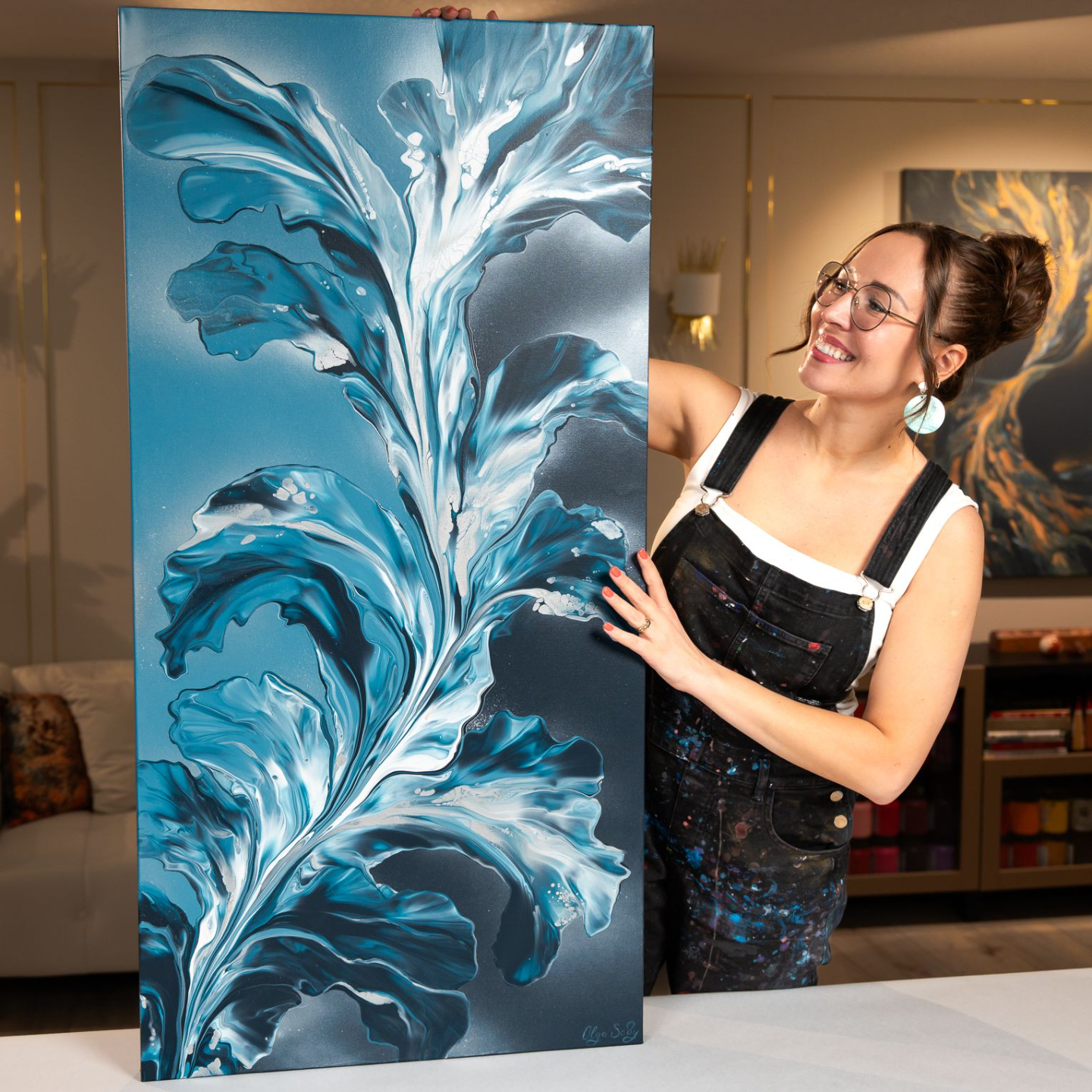


Search any social platform today for painting and you will quickly find it: a canvas tilted this way and that as ribbons of colour flow across it, marbling into cells and lacings and blooms that no brush could ever draw. Acrylic pouring, or fluid art, has become one of the most popular hands-on painting practices of the twenty-first century, embraced by hobbyists and contemporary gallery artists alike. It can look like a purely modern, even internet-native phenomenon — a craft born of cheap acrylics and a smartphone camera. But its roots run deeper and more seriously than that, reaching back to the radical experiments of the Mexican muralists in the 1930s and gathering conceptual force from the Pop art embrace of accident, repetition, and the commercial surface.
Start with the muralists, because the technical origin of controlled paint-pouring has a surprisingly specific history. In 1936, the great Mexican painter David Alfaro Siqueiros ran an experimental workshop in New York dedicated to new materials and methods. Siqueiros was impatient with the slow, traditional craft of easel painting; he wanted an art of the modern age, made with industrial paints, spray guns, and unorthodox techniques suited to bold public imagery. In that workshop he and his collaborators experimented with pouring and dripping industrial lacquers, and crucially with what he called the “accidental” method — pouring different coloured paints on top of one another and letting them interact. Because the poured layers had different densities and dried at different rates, they buckled and separated into organic, cellular patterns, the same kind of blooming and veining that fluid artists chase today. Siqueiros understood this as harnessing the material’s own behaviour rather than dictating every mark by hand.
The setting for this deserves a moment, because it was one of the genuine crucibles of modern technique. Siqueiros ran what he called the Experimental Workshop in New York in 1936, a “laboratory of modern techniques in art” where a group of younger artists gathered to test industrial paints and unorthodox methods for making bold, public, politically engaged imagery. Nitrocellulose lacquers of the kind used on cars, spray guns, stencils, and the deliberate exploitation of accident were all part of the toolkit. Siqueiros wanted an art adequate to the machine age and to the revolutionary politics he believed in, and he was contemptuous of what he saw as the precious, hand-fussed easel painting of the past. Pouring one colour over another and letting their different densities buckle into organic patterns was, for him, both a practical way to cover large surfaces expressively and a philosophical statement about working with modern materials rather than against them.
One of the young artists who attended that workshop was Jackson Pollock. It is not a straight line, but it is a real one: the muralists’ willingness to pour, drip, and let paint find its own patterns fed into the gestural revolution of Abstract Expressionism, and Pollock’s floor-based drip paintings a decade later share that foundational insight — that the artist can set up conditions and collaborate with gravity and fluid dynamics rather than illustrating a preconceived image. Fluid art is a direct descendant of this lineage. Every time a maker tilts a canvas and lets the paint decide where the cells form, they are working within a tradition that Siqueiros pioneered in the service of monumental, politically charged public murals.
Where does Pop art come in? Less in the physical technique and more in the attitude and the materials. Pop art, in the late 1950s and 60s, tore down the wall between fine art and commercial culture. It embraced industrial and household materials, mechanical and repeatable processes, bright commercial colour, and the idea that art need not be a precious, agonised, one-of-a-kind gesture. That spirit is everywhere in contemporary fluid art. The medium of choice — mass-market acrylic paint, often mixed with hardware-store pouring additives and silicone oil to encourage cells — is thoroughly democratic and commercial, exactly the kind of material Pop celebrated. The aesthetic, too, leans Pop: high-key colour, glossy resin finishes, decorative pattern embraced without apology. Fluid art tends to reject the earnest agonising of high modernism in favour of pleasure, accessibility, and reproducible technique, and that cheerful, unpretentious relationship to making is squarely in the Pop inheritance.
The technique itself rewards a little understanding, because knowing what is happening makes the results less magical and more masterable. Acrylic pouring works by manipulating the fluid dynamics of thinned paint. Artists mix acrylic paint with a pouring medium to achieve a specific flowing consistency, and often add a few drops of silicone oil or use a heat source to create “cells” — those characteristic rounded pockets where one colour breaks through another. The cells form largely because of differences in density and surface tension between the paint mixtures; lighter, less dense mixtures rise through heavier ones, and the silicone disrupts the surface so colours separate rather than blend. Common methods have their own names — the “dirty pour,” where multiple colours are layered in one cup and poured together; the “flip cup”; the “swipe,” where a top colour is dragged across others to reveal cells; the “ring pour” and “tree ring.” Each is a different way of setting up the initial conditions and then letting physics finish the painting.
The finished object matters too, and it is part of why fluid art has become a serious contemporary product as well as a craft. Many practitioners seal a poured painting under a coat of clear epoxy resin, which cures to a thick, glassy, mirror-flat surface that deepens the colours and gives the work a jewel-like glossiness quite unlike a conventional matte or varnished canvas. That high-gloss finish, combined with the metallic and interference pigments many fluid artists favour, produces works that read as luxurious and decorative in the best sense — objects that change as you move around them and catch the light. Contemporary artists have pushed the approach to large scale and museum-grade materials, using professional artist acrylics, archival pouring mediums, and controlled studio conditions to make big, resolved abstractions that command a wall. The same basic physics that a hobbyist explores at a kitchen table can, in disciplined hands and at ambitious scale, yield collectible contemporary art. What separates the two is rarely the technique itself and almost always the artist’s control over palette, composition, surface, and scale.
That partnership between control and surrender is the real subject of fluid art, and it is what connects the weekend hobbyist to the serious tradition. The artist controls the palette, the consistency, the sequence and manner of pouring, the tilt of the canvas — and then relinquishes the final pattern to the material. This is philosophically identical to what Siqueiros meant by the “controlled accident” and to what Pollock meant when he said he could control the flow of the paint even though there was no accident in the ordinary sense. Chance is not the absence of intention; it is a collaborator the artist has learned to work with.
For a gallery, fluid art occupies an interesting and sometimes contested place. At its most casual it is a craft, a joyful and accessible entry point that has brought countless people to the pleasure of making. At its most ambitious it is a genuine contemporary practice, with artists using pouring, resin, and layering to make large, resolved, collectible works that hold their own on a wall. The distinction usually comes down to intention and refinement — palette discipline, composition, scale, surface quality, and the artist’s control over an inherently unruly process. But whether encountered as craft or as fine art, fluid painting deserves more respect than its social-media ubiquity sometimes earns it. It is not a novelty. It is the living, popular continuation of a serious modern idea: that paint has its own behaviour, and that some of the most beautiful images come from letting a material be itself, guided by a hand that knows when to intervene and when to let go.