

There is a word you will meet again and again in contemporary galleries and print studios: giclée. It sounds refined and slightly mysterious, and it is often used as a badge of quality on fine-art prints. Behind the elegant French term lies a genuinely important technology — a way of reproducing images with a fidelity and, above all, a longevity that older printing could never match. For anyone buying a print, understanding what “archival giclée” actually means is the difference between an informed purchase and a leap of faith. The good news is that the substance behind the word is real: a properly made giclée is built to keep its colour, unfaded, for many decades.
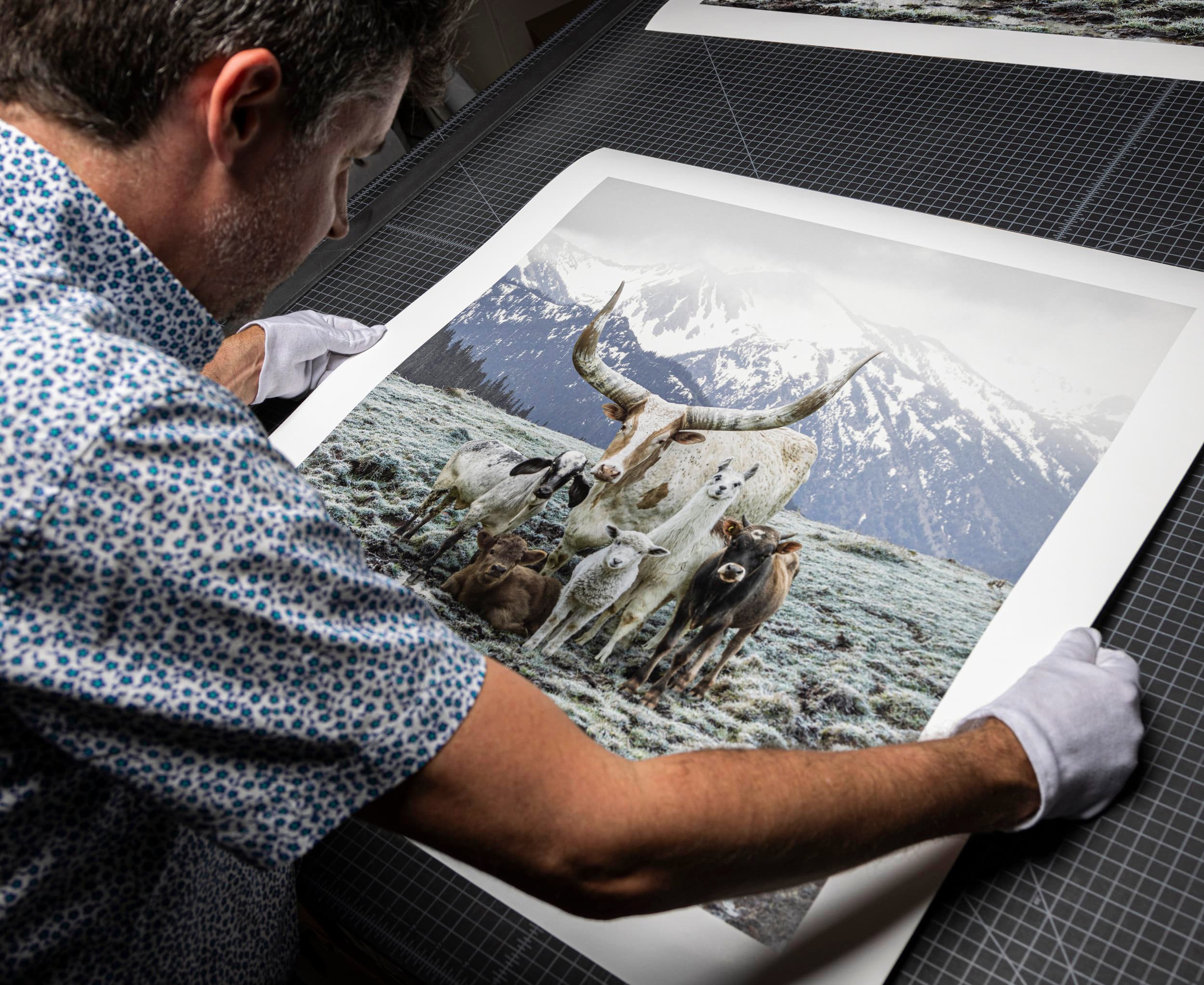
The word itself is worth demystifying. “Giclée” was coined around 1991, derived from a French verb meaning “to spray” or “to squirt,” to give a more dignified name to fine-art prints made on high-quality inkjet printers. Because at heart, a giclée is an inkjet print — but that phrase undersells it enormously. A fine-art giclée is made on a professional large-format printer that sprays microscopic droplets of ink through many nozzles, laying down an extremely high-resolution image with smooth, continuous-looking tone and an exceptionally wide range of colours. When the file, the inks, the printer, and the paper are all of archival grade, the result is a print of remarkable subtlety and depth. But the resolution and colour range, impressive as they are, are not the most important part of the story. The most important part is permanence, and permanence comes down to two things: the ink and the substrate.
The origins of fine-art giclée are worth knowing, because they explain why the technique earned artistic respect rather than staying a mere office technology. In the late 1980s and early 1990s, printmakers and photographers began adapting high-end commercial inkjet machines — notably the Iris printer, a device originally built for proofing in the graphic-arts industry — to output fine-art images. One early and influential studio, Nash Editions, founded by the musician Graham Nash and the print specialist Mac Holbert, pioneered the use of these machines for archival-quality art and photographic prints, refining the papers, inks, and colour management until the results rivalled traditional printmaking for subtlety. It was in this milieu that the term “giclée” was coined, precisely to give the new method a name free of the humble connotations of “inkjet.” The technology has advanced enormously since — today’s professional pigment printers far surpass those early Iris machines in colour range and permanence — but the ambition set in those first studios remains the standard: an inkjet print made with archival intent, treated with the seriousness of a fine-art edition.
The decisive distinction in print longevity is between dye-based and pigment-based inks, and it is the single most useful thing a collector can learn about prints. Dye inks dissolve the colourant fully in a liquid; they can be brilliant and cheap, and they are what many ordinary consumer printers use — but they fade, sometimes dramatically, when exposed to light and air over a few years. Pigment inks, by contrast, suspend solid particles of colourant, much like the pigments in fine paint, in the ink. Those solid particles are far more resistant to the ultraviolet light and atmospheric gases that break colour down. A print made with high-quality pigment inks is vastly more lightfast than a dye print. This is why archival giclée printing uses pigment-based inks — often the professional pigment ink sets developed specifically for fine-art and photographic printing. When a gallery says a print is “archival,” the use of pigment inks is a large part of what earns the word.
The second half of permanence is the paper or canvas the image sits on, and here another piece of chemistry matters: acidity. Ordinary paper is made with acids that, over time, attack the paper’s own fibres, causing it to yellow, grow brittle, and crumble — the fate of old newsprint left in a drawer. Archival substrates are acid-free (and often specifically “cotton rag,” made from cotton fibre rather than wood pulp), which means they are chemically stable and will not yellow or self-destruct over time. A true fine-art giclée is printed on acid-free, often 100 percent cotton rag paper or a comparable archival canvas, so that the surface holding the pigment is as long-lived as the pigment itself. Ink and paper together form the archival system; neither alone is enough.
How long is “decades,” concretely? Independent testing laboratories that specialise in the permanence of prints — most notably the research associated with Henry Wilhelm, whose accelerated light-fastness testing set the industry benchmark — have rated well-made pigment prints on quality archival papers to resist noticeable fading for many decades, and under good conditions well beyond a lifetime, when displayed away from direct sunlight and behind protective framing. The exact figures depend on the specific inks, paper, display conditions, and how the print is protected, and any honest gallery will frame such numbers as estimates from accelerated testing rather than guarantees. But the order of magnitude is real and represents a genuine leap over older reproduction methods, whose colours could shift within a few years. The practical promise of archival giclée is that a print bought today can be enjoyed by the next generation with its colours essentially intact.
A word about how those longevity figures are actually produced helps a buyer weigh them sensibly. No one can wait a hundred years to see whether a print fades, so permanence is estimated through accelerated aging: samples are exposed to intense, controlled light and to heat and humidity that compress years of normal display into weeks or months of testing, and the rate of fading is measured and extrapolated. This is a rigorous, scientific method — the industry benchmark associated with the Wilhelm research is widely cited for exactly this reason — but it is a projection, not a promise, and the numbers assume specific display conditions, usually framed under glass, away from direct sun, in a normal indoor environment. Real longevity depends on how the print is actually treated. This is why reputable sellers describe permanence as an estimate rather than a guarantee, and why the same print might last far longer in a shaded hallway than in a sunlit window. Understood this way, the ratings are genuinely useful: they let you compare the relative stability of different inks and papers with confidence, even if no single number is an oracle.
There are, sensibly, conditions attached, and they are worth stating plainly because they put the longevity partly in the owner’s hands. No print, however archival, is indestructible. Direct sunlight is the enemy of every pigment; even the most lightfast print will eventually shift if hung in a sunbeam for years. Humidity, smoke, and pollutants take their toll. The standard advice is to display prints out of direct sunlight, to frame them under UV-filtering glass or acrylic, and to use acid-free mounts and backing so that the framing materials themselves do not attack the paper. Follow those simple precautions and an archival giclée will hold its colour faithfully for the long span the technology promises.
It is also worth situating giclée honestly within the wider world of prints discussed in this collection. A giclée is usually a reproduction print — a high-fidelity print of an image that may originate as a painting, a drawing, a photograph, or a digital work — rather than an original print pulled from a hand-made matrix like an etching or silkscreen. That does not make it less beautiful or less permanent, but it is a different category, and a good gallery will always be transparent about which you are buying. Many contemporary artists issue their giclées as signed, limited editions, combining archival quality with the scarcity and personal endorsement that, as the essay on limited editions explains, add both value and assurance. Bought with clear eyes, an archival pigment print offers something genuinely valuable: a faithful, richly coloured, long-lived version of an artwork you love, made to a standard that will keep it glowing on your wall for decades. The elegant French name is, in this case, backed by real substance.