
Few techniques have changed the relationship between art and the public as thoroughly as silkscreen printing. It is the method behind Andy Warhol’s Marilyns and soup cans, behind concert posters and protest banners and the graphic on your favourite T-shirt. Silkscreen — also called screen printing or serigraphy — sits at a fascinating crossroads: it is at once a fine-art medium capable of museum masterpieces and a humble commercial process for printing on almost anything. That double nature is exactly what makes it such a powerful democratiser of images, and Warhol understood this better than anyone.
The technique is simple in principle, which is part of its power. A fine mesh screen — historically silk, now usually polyester — is stretched tight on a frame. A stencil blocks certain areas of the mesh so that ink cannot pass through them, leaving the image areas open. Ink is placed on the screen and pulled across it with a rubber blade called a squeegee, forcing colour through the open mesh onto the paper or fabric beneath. Each colour requires its own screen and its own pass, layered in register to build the full image. The result is a characteristically flat, dense, vivid area of colour — no brushwork, no gradation unless you engineer it, just clean saturated shapes. That flat graphic punch is why silkscreen looks the way it does, and why it married so perfectly to the aesthetic of Pop.
The technique’s own history explains its populist character. Stencilling — blocking parts of a surface so that colour reaches only the open areas — is ancient, but the refined method of forcing ink through a fine mesh developed over centuries, with important stencil-and-mesh traditions in East Asia, before emerging as modern screen printing in the early twentieth century. For its first decades it was overwhelmingly a commercial process: a cheap, versatile way to print signs, banners, bottles, textiles, wallpaper, and packaging, and during the twentieth century’s wars a practical way to mark flags, pennants, and equipment. In the 1930s some American artists began exploring it as a fine-art medium and coined the term “serigraphy” to distinguish artistic screen prints from commercial work. So by the time Warhol arrived, silkscreen carried a double identity — a workhorse of advertising and manufacturing on one hand, a recognised if minor fine-art technique on the other. That very duality, the fact that it belonged to the commercial world and the art world at once, was precisely what made it perfect for an artist bent on collapsing the distance between the two.
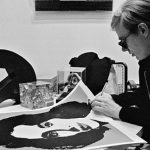
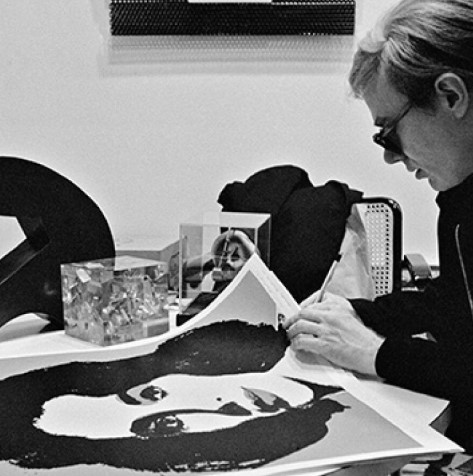
Warhol adopted silkscreen in the early 1960s, and it was the ideal vehicle for everything he wanted to say. He was fascinated by mass production, celebrity, consumer packaging, and the endless repetition of images in modern media — and silkscreen is itself a mass-production technique. Rather than fight the mechanical, impersonal quality of the process, he embraced it. He photographically transferred images — a publicity still of Marilyn Monroe, a news photo, a dollar bill, a Campbell’s soup label — onto screens and printed them over and over, sometimes in grids of identical repetitions, sometimes in gaudy off-register colours that echoed cheap commercial printing. He famously said he wanted to be a machine, and he spoke of wanting to erase the sacred distance between the artist’s unique touch and the manufactured image. Silkscreen let him do exactly that. His studio was even called the Factory. The medium and the message were one: art made the way soup cans are made, about the world that makes soup cans.
This was radical, and it cut to the heart of what art was supposed to be. For centuries the value of a painting rested partly on its uniqueness and on the evidence of the artist’s hand — the aura of the singular object, touched by genius. Warhol’s silkscreens deliberately dissolved that aura. Here was art that was flat, repeatable, photographically sourced, and often made with assistants pulling the squeegee. It asked, provocatively, whether the emperor’s uniqueness was really the point, and whether an image drawn from shared commercial culture and reproduced could be just as meaningful — or more so — than a one-off oil painting. In doing so it helped tear down the wall between “high” fine art and “low” commercial imagery, one of the defining achievements of Pop.
The accessibility that silkscreen introduced operated on several levels at once, and this is where the “made art more accessible” of the title really lives. First, imagery: silkscreen drew its pictures from the shared visual world everyone already knew — famous faces, brand packaging, headlines — so the art spoke a language the general public read fluently, with no special education required. Second, multiplicity: because the process produces many impressions, silkscreen prints could be issued in editions, spreading an artist’s work to many owners at accessible prices rather than concentrating it in a single unaffordable object. A Warhol print put a genuine Warhol within reach of people who could never buy a unique painting. Third, and more broadly, the technique itself is cheap, portable, and learnable. The same method that produced gallery masterpieces also produced political posters, album covers, band merch, and activist graphics — art that lived in the street and on the body rather than behind museum glass. Silkscreen became the medium of choice for anyone who wanted to get a strong image in front of many people quickly and affordably.
The political dimension of that accessibility is worth naming, because silkscreen has always been a medium of the message as well as the market. Its cheapness, portability, and ability to reproduce a bold image quickly made it the natural tool of protest and propaganda throughout the twentieth century, from wartime posters to the radical print workshops of the 1960s and the graphics of countless social movements. A single hand-cut screen could turn out hundreds of posters overnight, putting a slogan or an image into the streets faster and cheaper than any other method. That lineage runs straight into the present: Shepard Fairey’s instantly recognisable street-poster campaigns descend directly from this tradition, blurring the same line between graphic activism, commercial design, and gallery art that Warhol played with. Silkscreen has never been only a way to make pretty editions; it has been a way to get a picture in front of a crowd.
That democratic character has carried straight into contemporary galleries and studios, where screen printing remains vital. Street and graphic artists have used it to move fluidly between the wall, the poster, and the collectible edition, keeping the medium’s populist energy while producing works that galleries eagerly show. Contemporary printmakers exploit its flat colour and layering for sophisticated fine-art editions, and studios large and small continue to issue signed, numbered silkscreen prints that let collectors own original, artist-made work at approachable prices. The technique’s accessibility runs in both directions: it lowers the cost of owning real art, and it lowers the barrier to making it.
For a gallery, silkscreen is a natural bridge between the worlds this collection keeps returning to — the rare and the reachable, the unique and the multiple. A screen print can be a serious original artwork, conceived for the medium, signed and numbered and every bit as authentic as an etching or a lithograph, as discussed in the essay on limited editions. It can also be a joyful, affordable point of entry for a new collector, or a bold graphic statement that would feel out of place in oil. Warhol’s great insight was that these are not contradictions. Art can be reproducible and meaningful, commercial and profound, mass-produced and still original. Silkscreen is the technique that proved it, and its legacy is a broader, more open idea of who art is for.