

When people picture mid-twentieth-century American painting — the vast splattered canvases of the Abstract Expressionists, the crisp comic-strip panels and repeated soup cans of Pop — they are looking, more often than not, at acrylic. In the space of a single generation, a paint that barely existed commercially before the 1950s became the defining medium of the most important art movements of postwar America. This was not a coincidence of fashion. Acrylic had a specific set of properties that answered, almost point for point, what these two very different movements were reaching for. Understanding why they adopted it tells you a great deal about what each movement actually wanted from painting.
First, the material itself. Acrylic paint is pigment suspended in an acrylic polymer emulsion carried in water. When the water evaporates, the polymer particles coalesce into a clear, tough, flexible plastic film. The practical consequences of that chemistry are dramatic when set against oil. Acrylic dries in minutes to hours rather than days to weeks. It thins and cleans up with plain water rather than turpentine and other solvents. It can be applied in a whisper-thin transparent stain or a thick sculptural mound and, once cured, it does not yellow, does not grow brittle, and remains flexible for decades. It bonds to almost anything — raw canvas, board, paper, plastic, metal — without a traditional ground. Each of these traits turned out to matter enormously to the painters of the 1950s and 60s.
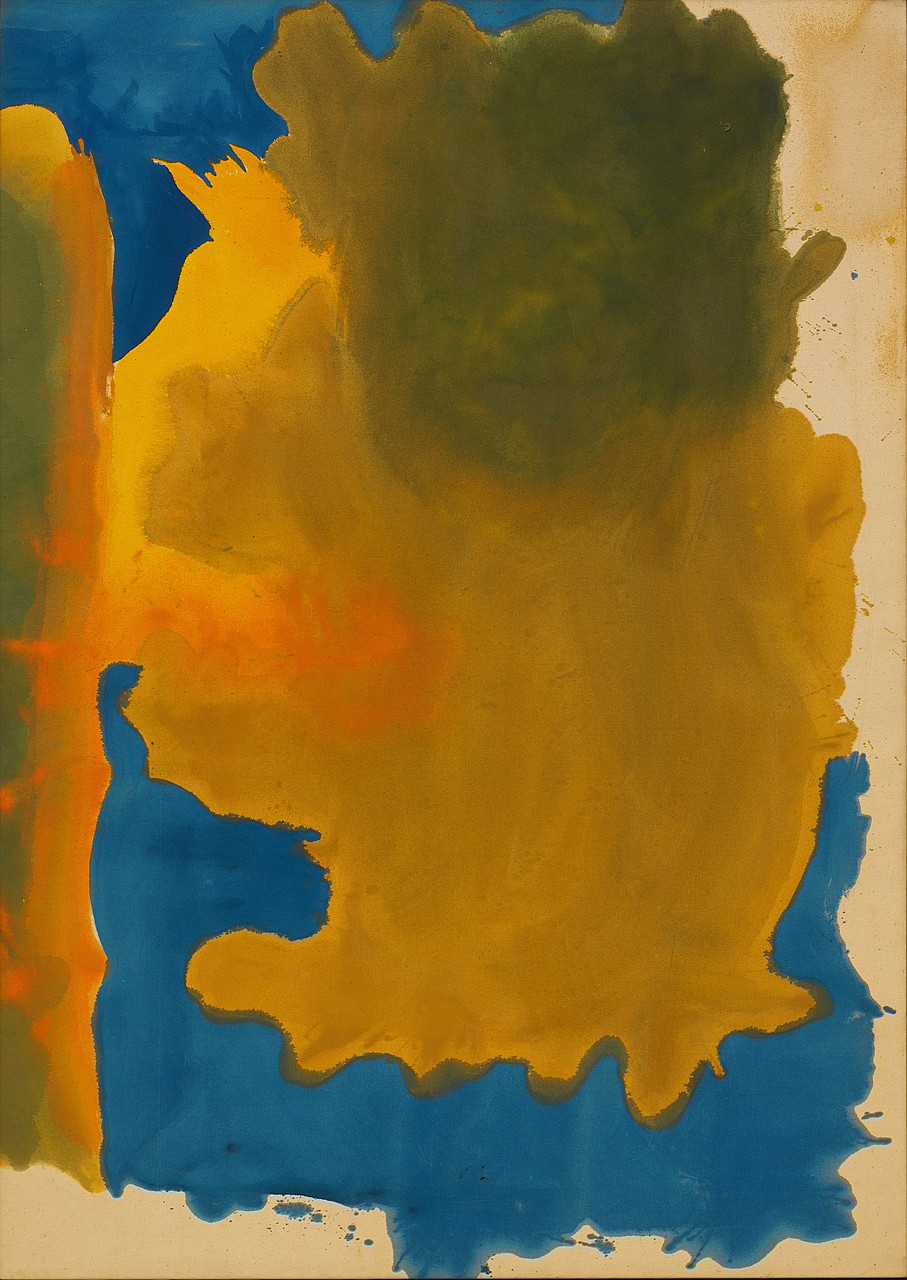
For the Abstract Expressionists, and especially the Color Field wing of that movement, the decisive properties were water-thinning, fast drying, and the ability to stain raw canvas without destroying it. As the earlier essay on Helen Frankenthaler describes, Color Field painting was built on soaking thinned paint directly into unprimed cotton so that colour and canvas became one luminous, edgeless field. Oil could not do this safely; acrylic could. Morris Louis, Kenneth Noland, and their peers needed a paint they could pour, flood, and stain across huge canvases, that would sink in rather than build up, that would keep its colour clean and unyellowed for the life of the work, and that would not rot the fabric it was poured onto. Acrylic met every one of those needs. The fast drying time also allowed them to lay one transparent veil of colour over another in a single working session, building the overlapping translucent waves that define Louis’s greatest paintings — something oil’s slow drying would have made maddeningly slow. The flat, matte, weightless surface of a Color Field painting, so different from the buttery gloss of oil, is itself a direct expression of acrylic’s character.
Even the more gestural, brush-and-drip wing of Abstract Expressionism found acrylic congenial as it became available, because scale and speed were of the essence. These painters worked large and fast, often on the floor, chasing the energy of a single sustained act of painting. A medium that dried quickly enough to build up layers within a working period, that could be thinned to a pourable flow or loaded thick, and that did not fill the studio with solvent fumes at mural scale suited that way of working. Acrylic let the painting keep pace with the painter’s body.
For the Pop artists, the appeal of acrylic was different but equally decisive, and it comes down to surface and attitude. Pop art wanted to look like the commercial, printed, manufactured world it drew its imagery from — advertisements, packaging, comics, billboards. It wanted flat, even, unmodulated fields of bright colour with clean hard edges and no evidence of the artist’s agonised hand. Acrylic is almost purpose-built for this. It dries to a flat, opaque, uniform film with no brushmarks if applied carefully, and its fast drying makes crisp, hard-edged shapes easy: you can mask an area, lay down a second colour, and get a clean boundary without waiting days for the first colour to dry or worrying about it lifting. The colours themselves are bright, saturated, and modern-looking, echoing the commercial inks Pop was quoting. Roy Lichtenstein’s flat primary fields and mechanical precision, and the broad areas of even colour in much Pop painting, sit naturally in acrylic. The medium’s very newness and its association with industry and plastic — with the modern manufactured world rather than with the varnished tradition of the old masters — was itself part of the appeal to a movement that wanted to close the gap between fine art and commercial culture.
The commercial history of the paint is woven through this artistic one, and it explains the timing. The first acrylics available to American artists arrived in the late 1940s and 1950s through the paint-maker Leonard Bocour, whose solvent-based Magna acrylic was used by Color Field painters and even, in his black paintings, by an artist as austere as Ad Reinhardt. Water-based acrylic emulsion paints designed for artists followed in the mid-1950s and rapidly became the standard, precisely because they combined every practical advantage — water clean-up, fast drying, flexibility, colour stability — in one convenient medium. By the 1960s a painter could walk into an art-supply store and buy tubes and jars of bright, reliable acrylic off the shelf, and a whole generation did. The medium’s ready availability and ease of use were themselves part of the democratic, contemporary spirit that both movements embraced: this was modern paint for modern art, unburdened by the varnished mystique of the old studios.
The Pop artists put that modern paint to unmistakable use. David Hockney, working in Los Angeles in the 1960s, adopted acrylic for exactly the flat, bright, even fields it produces so easily — the cloudless blue of a swimming pool, the clean planes of California light and architecture in a painting like A Bigger Splash, where the placid surface is interrupted only by the white flurry of the splash itself. Roy Lichtenstein’s comic-strip paintings depend on flat primary colour and hard, mechanical edges that acrylic makes straightforward to achieve. Across Pop, the look of the printed, commercial, manufactured image — even, saturated, edge-defined — was easiest to reach in a paint that dried fast and flat, and acrylic delivered it.
There is a deeper thread linking both movements’ embrace of acrylic: a rejection of the aura of oil. Oil paint carried centuries of connotation — the museum, the varnish, the slow craft, the precious unique object touched by the master’s hand. Both Abstract Expressionism and Pop, in different ways, were pushing painting into new territory, and a new, industrial, unpretentious medium helped them get there. For the Color Field painters, acrylic meant a democratic, weightless, colour-first purity free of oil’s tradition-laden gloss. For Pop, acrylic meant the flat commercial surface of contemporary life. In each case the medium was not neutral; it was part of the message.
Andy Warhol’s practice sits interestingly across this whole story, because his most famous works combine acrylic grounds with silkscreen printing on canvas — a subject explored in its own essay in this collection. But the broader point holds: the flat acrylic field was the natural bed for Pop’s printed, repeated, commercial imagery, just as the poured acrylic stain was the natural body for Color Field’s luminous abstraction.
It is worth adding a note of balance, because acrylic did not simply defeat oil, and many great painters of the period continued to prize oil’s blending and depth for exactly the qualities acrylic lacks — its long open working time, its capacity for subtle wet-in-wet transitions, its glazed luminosity. Acrylic’s fast drying, so useful for hard edges, is a liability if you want to blend softly for hours. The two media are genuinely different instruments, and the mid-century revolution was less about one replacing the other than about a new medium arriving precisely when new movements needed exactly what it offered. Abstract Expressionism and Pop did not choose acrylic by accident or mere availability. They chose it because its flatness, speed, water-base, colour clarity, and modern character were the physical form their ideas demanded. The medium and the moment fit each other, and the result was some of the most recognisable art of the century.